

Maryland driving education requirements are clear: new drivers must complete an MVA-approved driver’s education course. According to the Maryland Motor Vehicle Administration, the course includes at least 30 hours of classroom instruction and six hours of behind-the-wheel instruction.
It’s understandable to want the Maryland driving education requirements in one clear sequence. Course attendance, learner’s permits, and supervised practice each play a separate role, and practice rules vary by age. This guide explains how the stages fit together and which completion records are used when applying for a provisional license. Keep course hours, permit-holding periods, and supervised practice distinct: one does not replace another.
Key Takeaways
- Plan for an MVA-approved driver’s education course, including 30 hours of classroom instruction and six hours behind the wheel.
- Know the first-class attendance and permit rules before starting, including the parent or guardian requirement for students under 18.
- Keep supervised practice requirements and permit-holding periods in view, since they differ by age.
- Understand how course completion is reported and which records to prepare for a provisional license application.
Is driver’s ed required in Maryland?
Yes. New drivers must complete approved driver education, including classroom and behind-the-wheel instruction. Applicants under 25 also have supervised practice requirements before progressing through graduated licensing.
Classroom and Behind-the-Wheel Training
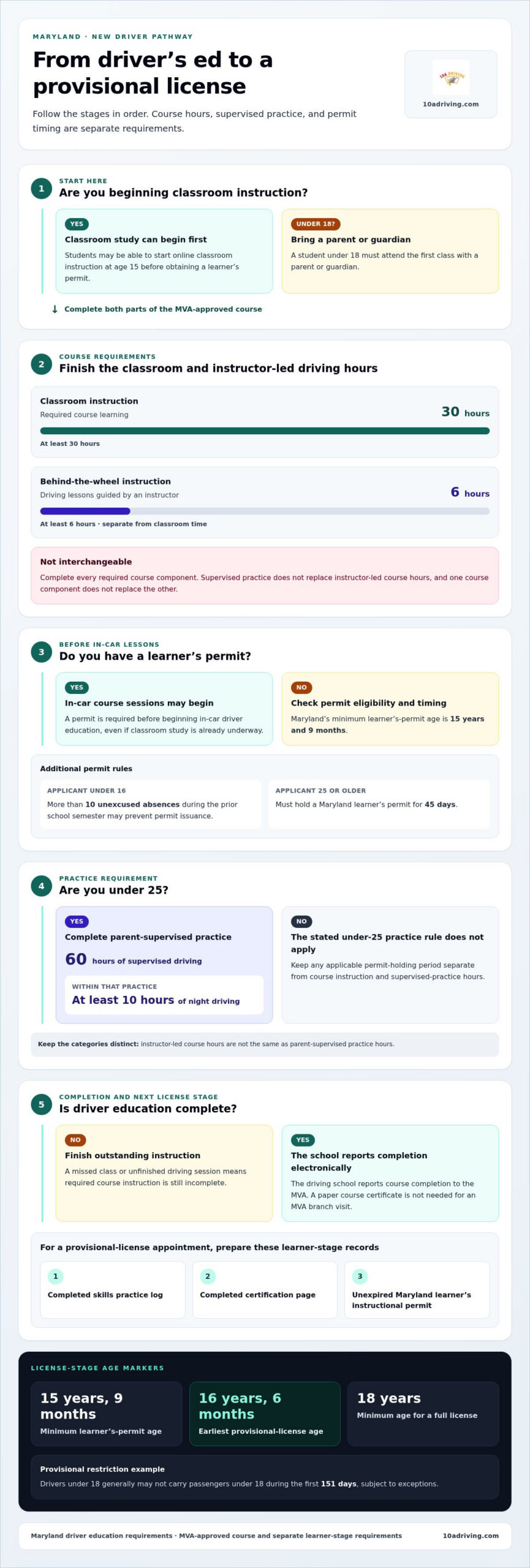
Driver education combines classroom learning with supervised driving instruction. According to the Maryland Motor Vehicle Administration, new drivers must complete at least 30 hours of classroom instruction in an MVA-approved driver’s education course. They must also complete at least six hours of behind-the-wheel instruction in an MVA-approved course.
Behind-the-wheel instruction means learning to operate a vehicle with an instructor guiding the lesson. Follow the instructor’s directions, adjust the seat and mirrors before moving, and focus on the driving task. These lessons connect classroom knowledge with practical vehicle control. Choose an MVA-approved course so the required instruction counts toward driver education completion.
Training Hours
Training hours are the required time spent in classroom lessons and in-car instruction. The classroom requirement is at least 30 hours, while behind-the-wheel instruction requires at least six hours. These are separate course components, not interchangeable blocks of time.
Supervised practice is separate from the approved course. According to the Maryland Motor Vehicle Administration, applicants under 25 must complete 60 hours of parent-supervised driving practice. The same applicants must complete at least 10 hours of night driving practice, according to the Maryland Motor Vehicle Administration. Keep practice hours distinct from instructor-led course hours when planning permit-stage learning.
A missed class or unfinished driving session leaves required course instruction incomplete. Complete all outstanding components before considering driver education finished; otherwise, the learner cannot meet this part of Maryland’s graduated licensing process. For practical lessons, arrive ready to listen, follow directions, and build skills step by step. Classroom study helps learners recognize traffic situations, while supervised in-car instruction lets them apply that knowledge.
First-class attendance and permit requirements
Classroom attendance and permit timing affect when a student can begin driver education. Maryland separates classroom learning from in-car instruction, so plan for both stages.
Classroom Instruction and Operation
Classroom instruction is the course component covering driver education before practical lessons. Students learn in a classroom or, where offered, through online classes. Students may be able to begin the online classroom portion of driver education before obtaining a learner’s permit.
For the first class, for the theory part, students under 18 advised attending with a parent or guardian. For the in-car training, the first-class attendance is distinct from the theory part (either online or in class). Keep the start of Behind-the-wheel (in-car) training arrangements clear so the student and accompanying adult arrive together if under 18 years old.
Classroom Instruction Hours
Classroom instruction hours are the required time spent completing the classroom portion of driver education. The required classroom total is 30 hours. This class time counts separately from behind-the-wheel instruction, which takes place during practical driving lessons.
Use the school’s course schedule to track class attendance and remaining instruction. An online class can provide a way to begin at age 15 without a permit, but it doesn’t remove the classroom-hour requirement. Complete the required lessons before treating the classroom portion as finished.
A learner’s permit is the authorization needed before a student takes in-car driver education sessions. Students must have a permit before beginning those sessions, even if they have already started classroom study. Maryland’s minimum learner’s-permit age is 15 years and 9 months.
Permit eligibility can also depend on school attendance. Maryland may not issue a permit to an applicant under 16 who had more than 10 unexcused absences during the prior school semester. Applicants 25 and older must hold a Maryland learner’s permit for 45 days. These rules affect permit timing, not permission to begin online classes at age 15.
For a smooth sequence, begin with classroom instruction, attend the required first class, and obtain a learner’s permit before scheduling in-car lessons. Each step meets a different requirement, so completing one does not replace another.
Completion verification and provisional license documents
Completion verification records that a student finished Maryland driver education. The driving school reports course completion electronically to the Maryland Motor Vehicle Administration (MVA), so students do not need a paper certificate for an MVA branch visit. The MVA manages Maryland driver licensing.
An approved provider is a driver education school approved by the MVA. Only a course from an MVA-approved school counts toward the requirement. Before enrolling, confirm the school’s approval status and keep course records available in case completion details need to be resolved.
A provisional license is the next licensing stage after a learner meets Maryland’s Rookie Driver requirements. The earliest provisional license age is 16 years and 6 months. The minimum learner’s permit age is 15 years and 9 months, and a driver must be at least 18 years old to receive a full license.
For a provisional-license appointment, bring the required learner-stage records: a completed skills practice log, a completed certification page, and an unexpired Maryland learner’s instructional permit. Review each item ahead of time so the log, certification, and permit are ready together.
Maryland’s Rookie Driver program is the graduated licensing system for new drivers. It moves learners from a permit to a provisional license, then to a full license, with restrictions during the stages. For example, provisional drivers under 18 generally may not carry passengers under 18 during the first 151 days, subject to exceptions. An exception allows those passengers when a licensed adult at least 21 years old, with at least 3 years of driving experience, is present.
Electronic reporting and appointment documents serve different purposes: the school reports driver education completion, while the applicant brings practice and permit records. Keep both in mind as you prepare for the licensing step. Meeting the age and Rookie Driver requirements does not replace presenting the required provisional-license documents.
Certification of program completion
Certification of program completion confirms that a student finished an approved driver education program. In Maryland, the driving school reports course completion electronically to the MVA. That report connects the completed program to the student’s licensing record. Keep your course details available to help identify the correct record if questions arise.
Out-of-state certification follows a separate review process. Maryland accepts driver education completion from certain states and programs. The MVA reviews an out-of-state completion request and contacts the applicant within two business days. If the request is approved, the MVA provides a letter to bring to an appointment as proof of completion. Keep the letter with your appointment documents.
A school closure can affect how completion is documented. When a Maryland driving school closes, it must send student records dating back three years from the closure date to the MVA. If a school closes unexpectedly, the MVA reviews available documentation and gives credit for training already completed. Keep course records and payment receipts together, as they can help establish which training took place.
For students affected by a closure, a replacement school determines what training remains and its cost. The completion record and evidence of prior training help separate finished instruction from outstanding requirements. Organize records by course component, such as classroom instruction and vehicle training, before discussing next steps.
Use a consistent recordkeeping process: retain school documents, note completed course components, and bring any MVA approval letter to the relevant appointment. For guidance with driver education planning, continue with driver education support.
10A Driving School Silver Spring: Driver’s Education
10A Driving School Silver Spring offers Driver’s Education for learners working through Maryland’s course requirements. Its MVA-certified training provides a structured option for students preparing to complete driver education.
Choose Driver’s Education when you need the required course. If you want more time to practice driving skills, Extra Practice/Personal Practice may suit that need. The school also offers MVA road test day escort (car rental) Driver Improvement Program and 3-Hour Roadway Safety.
Use the requirements above to identify the support that fits your next step. Driver’s Education is relevant for completing the course; extra practice is for additional skill practice. Contact 10A Driving School Silver Spring to discuss its driver education services.
Take Your Next Step Toward Confident Driving
Use your course plan to decide what support will help you keep learning. Understanding the Maryland driving education requirements is one part of becoming a prepared driver; steady practice and sound judgment matter on every trip.
10A Driving School Silver Spring offers Driver’s Education for learners completing their course, Extra Practice/Personal Practice for additional driving practice, and a Driver Improvement Program. Choose the service that matches your current learning goal and stage.
If you’re ready to move forward, contact 10A Driving School Silver Spring to discuss the appropriate next step. Keep building your skills with patience, preparation, and a consistent focus on safe driving.
Frequently Asked Questions
Do I get a certificate to bring to the MVA?
A paper certificate is not needed for a Maryland driver education course. The driving school reports completion electronically to the MVA. Keep your course records for reference, but distinguish them from documents you must bring to a provisional-license appointment: the completed skills practice log, certification page, and unexpired learner’s instructional permit.
Does MVA accept out-of-state driver’s education?
Maryland accepts out-of-state driver education only from certain states and programs. Submit a completion request for review. The MVA reviews it and contacts the applicant within two business days. If approved, the applicant receives a letter to bring to an appointment as proof of completion. Keep records identifying the course and program together when submitting the request.
How long do you have to hold a permit in Maryland?
The holding period depends on the applicant’s age. Applicants under 25 must hold a learner’s permit for 3 months before applying for a provisional license. Applicants 25 and older must hold a Maryland learner’s permit for 45 days. Record the permit issue date so you can track when the applicable period ends and plan the next licensing step.
How many hours of classroom instruction and behind-the-wheel training are required in Maryland?
The Maryland driving education requirements include at least 30 classroom hours and six hours of behind-the-wheel instruction. These are separate course components, so completing one doesn’t replace the other. Applicants under 25 also have parent-supervised practice requirements outside the course. Keep course instruction and supervised practice in separate records to track each requirement accurately.
What is the minimum age to enroll in Maryland driver education?
Students can start online driver education classes at age 15 without a learner’s permit. This applies to online classes; a permit is required before in-car driver education sessions. Maryland’s minimum learner’s permit age is 15 years and 9 months. A student can therefore begin online study before becoming eligible for the permit needed for practical lessons.
What are the Maryland learner’s permit requirements and steps?
First, meet Maryland’s minimum learner’s permit age of 15 years and 9 months. Applicants under 16 should account for school attendance because more than 10 unexcused absences during the prior semester can prevent permit issuance. After receiving a permit, track its holding period and complete the required practice before moving to the provisional license stage.

