

Teens who take driver education have a 21% lower crash rate than teens who do not. In Silver Spring, structured driver education for teens provides professional instruction in road rules and safe vehicle operation, while driving practice helps learners apply those skills on the road.
Choosing where a teen trains is an important first step. Families also need a clear picture of permit and licensing timelines, what supervised practice should cover, and how driver education fits into a careful approach to teen driving.
This guide explains where teens can receive driver training, how the permit-to-license process is structured, and how local-road and highway practice can build experience. It also looks at the reported crash-rate difference, so families can weigh driver education as part of a careful approach to teen driving.
Key Takeaways
- Compare where teens train and how class formats combine instruction with practical learning.
- Understand the steps from a beginner’s permit toward licensing, and what shapes the timeline.
- Use supervised practice to build skills on local roads and highways before a road test.
- See how driver education relates to teen crash outcomes and where structured instruction can support safer driving habits.
Driver education provider locations and class formats
In Silver Spring, teens can take classroom instruction online or in person, then complete in-car training. Maryland’s MVA-approved driver education includes 30 classroom hours and 6 hours behind the wheel. The suitable class format depends on the teen’s schedule and access to driving lessons.
Classroom Instruction
Maryland’s 30-hour classroom component covers the MVA curriculum, including traffic laws, impairment avoidance, vehicle knowledge, and road conditions. Teens can complete these lessons online or in person. For a standard Maryland driver’s license pathway, families should distinguish classroom hours from in-car instruction and supervised practice. Each fulfills a different part of learning: classroom lessons build knowledge, while driving practice develops vehicle-control skills.
Schedules and Locations
Class schedules and training locations affect how easily a teen can attend consistently. Compare online access with travel to an in-person classroom, then consider where in-car lessons begin. For example, a Silver Spring family can plan transportation to classroom sessions separately from driving appointments. Review how the 30 classroom hours and 6 in-car hours fit around school commitments, and leave room for supervised practice between lessons.
School and Online Program Options
Maryland MVA-approved driving schools connect classroom learning with instructor-led in-car training. Online classes provide remote classroom access, but they do not replace the required driving component. In live online classes, students must remain visible to their instructor and participate actively. When comparing courses, consider MVA approval, lesson format, instructor involvement, and how completion is recorded. These details help families choose training that fits Maryland’s licensing pathway.
Teen beginner’s permits and licensing timelines
Teen permit and licensing timelines depend on the state where the teen applies. For families in Silver Spring, Maryland’s MVA process is the relevant pathway. Plan in sequence: identify the teen’s age and education category, meet permit requirements, complete driver education, hold the permit for the required period, and finish supervised practice before the next licensing step. Other states set their own rules.
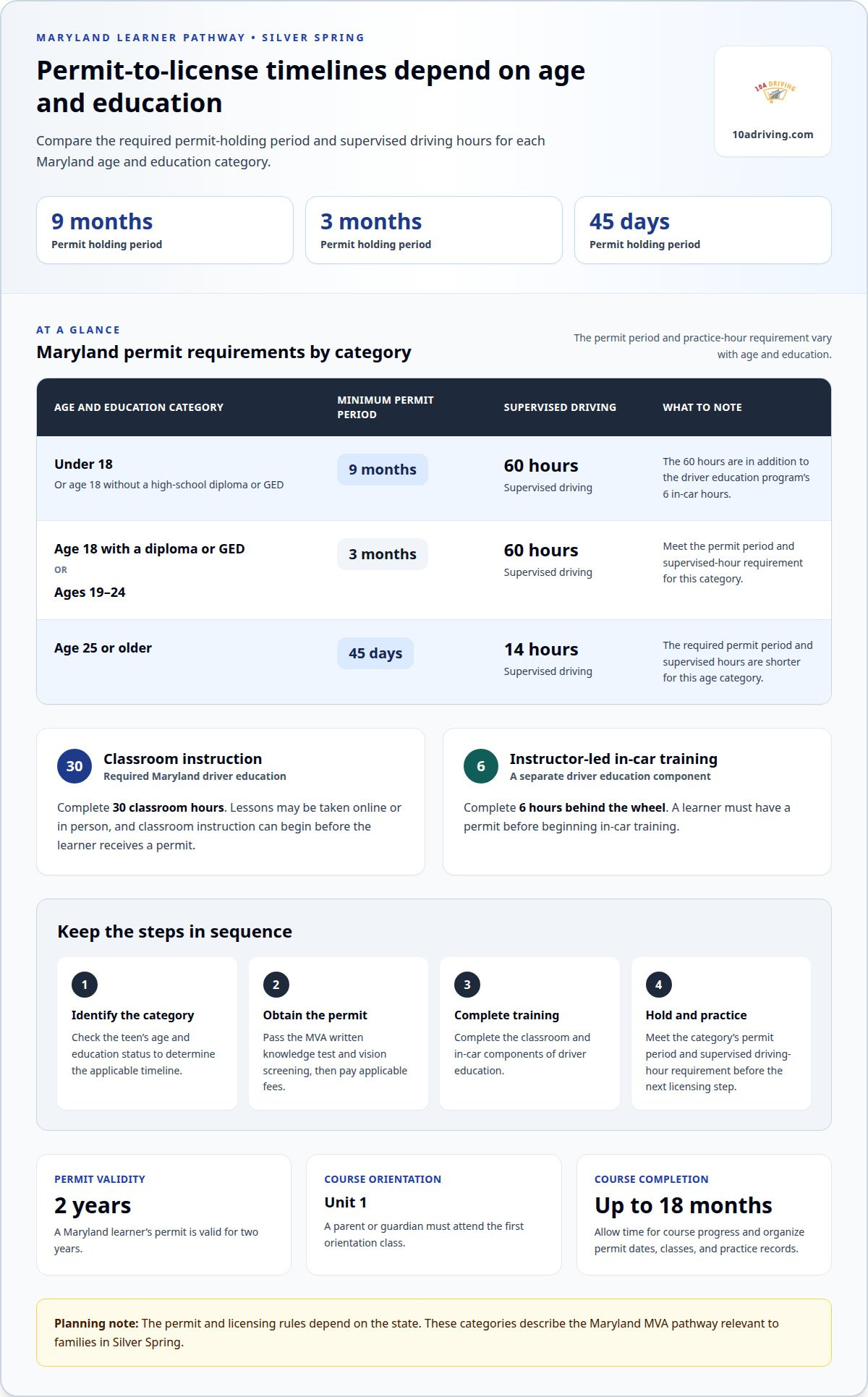
In Maryland, getting a learner’s permit requires passing the MVA written knowledge test and vision screening, then paying applicable fees. The permit is valid for 2 years. A teen can start classroom instruction before receiving it, but must have the permit before beginning in-car training. Keeping permit details and course records together helps families track these steps.
The permit-holding period and supervised driving hours depend on age and education. Someone under 18, or age 18 without a high-school diploma or GED, must hold a permit for 9 months and complete 60 supervised driving hours, in addition to the included 6 hours. Someone age 18 with a diploma or GED, or ages 19-24, must hold a permit for 3 months and complete 60 supervised hours. At age 25 or older, the requirement is 45 days and 14 supervised hours.
Build the timeline around the teen’s category and course progress. In Maryland, the first orientation class, Unit 1, requires a parent or guardian to attend. Course completion can take up to 18 months, so keep enrollment and required steps organized. A simple calendar can track permit dates, class sessions, supervised practice, and remaining requirements without treating the road test as the next immediate step.
For instruction that fits Maryland’s teen driver education pathway, explore Maryland driver’s education.
Local-road and highway driving practice
Start practice on familiar Silver Spring streets with manageable traffic. Before moving, have the teen adjust the seat and mirrors, check the surroundings, and describe the next turn. On residential roads, focus on smooth starts, controlled stops, signaling, and watching for pedestrians. Introduce one new condition at a time. For example, try a familiar route in busier traffic only after the learner handles its turns and intersections consistently.
Use each drive to practice specific skills rather than tackling too many situations at once. A local-road session might focus on scanning intersections, maintaining space, or choosing a safe lane position. Ask the teen to identify signs and potential hazards aloud. After parking, review one decision that went well and one that needs more practice. This gives the next drive a clear purpose.
Introduce highway driving after the teen can manage basic vehicle control and traffic awareness on local roads. Practice entering and exiting, checking mirrors and blind spots, maintaining steady spacing, and responding calmly to changing traffic. Choose a suitable route and conditions that give the supervising adult room to offer clear guidance. Avoid combining an unfamiliar highway with several new challenges in one session.
For Maryland learners, the permit-holding and supervised-practice requirements depend on age and education. Keep a written practice log with the date, route type, conditions, and skills addressed. If a teen needs targeted feedback, an adult driving lesson can focus on a specific challenge, such as merging or scanning intersections. Then reinforce that skill during supervised drives around Silver Spring. Consistent notes help families spot areas needing more practice and plan the next session around the learner’s progress.
Crash rates among teens who take driver education
Driver education is associated with lower crash and traffic-conviction rates among teens. Teens who take driver education have a 21% lower crash rate than teens who do not. They also have a 57% lower rate of traffic convictions. These comparisons give families a useful reason to consider formal instruction alongside supervised driving practice.
The figures describe differences between groups, not a prediction for an individual teen. They also do not show that classroom lessons alone explain the outcomes. Teens still need practice applying road rules, judging traffic, and responding to changing conditions. For example, a lesson on right-of-way becomes useful when a learner can recognize who should proceed at an intersection.
When choosing structured driver education for teens, look beyond a completion certificate. Compare what the course teaches, how instruction connects with driving practice, and whether students participate actively. In live online classes, students must remain visible to their instructor and take part in learning. These expectations support engagement, while practical skills still need to develop through driving.
A useful next step is to identify the teen’s learning needs. A new learner may need structured lessons on basic rules and vehicle control. A teen with some experience may benefit from focused practice in specific situations, such as merging or scanning for hazards. Track the skills that need attention, then use them to guide the next lesson or supervised drive. This makes progress easier to discuss and practice more purposeful.
Use the 21% lower crash rate and 57% lower traffic-conviction rate as context, not as substitutes for careful instruction and practice. Review driver education options to find instruction that supports a teen’s next steps toward safer driving.
10A Driving School Silver Spring: Driver’s Education
10A Driving School Silver Spring offers Driver’s Education for teens building foundational knowledge and driving skills. Families can turn to the school for instruction that supports a learner’s preparation and next steps. For additional practice, Extra Practice/Personal Practice can help teens focus on skills they want to strengthen.
The school also offers a Driver Improvement Program and 3-Hour Road Way Safety. These offerings serve different learning needs, so consider the teen’s goal when deciding which is relevant. Driver’s Education is the fitting starting point for a teen learning road rules and developing driving skills; extra practice can support focused skill-building.
Contact 10A Driving School Silver Spring to discuss driver education for your teen.
Make the Next Driving Lesson Count
As your teen moves toward independent driving, keep learning active beyond formal instruction. Before each drive, agree on one skill to focus on and how feedback will be shared. Afterward, discuss what felt clear and what deserves more practice. This simple routine helps families keep progress visible without treating every drive as a test.
Structured driver education for teens works best as part of steady, attentive learning. Encourage the teen to take increasing responsibility for raising questions and setting goals. A parent or guardian can support the process by listening, staying consistent, and helping make each next step manageable.
For guidance on the next step in your teen’s driver education, contact 10A Driving School Silver Spring. A thoughtful plan can help your teen continue building sound judgment and confidence on the road.
Frequently Asked Questions
Where do students train?
Students can complete classroom learning online or in person, with behind-the-wheel training arranged separately. The Silver Spring location is at 109 University Blvd West, Silver Spring, MD 20901. It can serve as a local training base for families in Silver Spring, Burtonsville, Colesville, Beltsville, Hyattsville, Kensington, Rockville, and Bethesda. Choose the classroom format around the teen’s schedule and access to in-car lessons.
What is structured driver education for teens?
Structured driver education for teens combines classroom learning with in-car instruction in a planned course. Maryland’s MVA-approved Driver’s Education program includes 30 classroom hours and 6 hours behind the wheel. The classroom portion covers the MVA curriculum, including traffic laws, impairment avoidance, vehicle knowledge, and road conditions. Instructors evaluate students during in-car sessions and adapt instruction to their progress.
What is the typical cost of teen driver education, and what financial assistance is available?
Price depends on the case and is provided after a quote request; factors include the selected program and instruction needs. For budgeting, distinguish payment timing from financial assistance. Tuition is paid in thirds: at registration, at the end of the first week, and before the final exam. Accepted payment methods include online, by phone, in person, or by check.
What are the steps for enrolling in teen driver education and getting a learner’s permit?
Start classroom instruction, then obtain a learner’s permit before beginning in-car training. To get the permit in Maryland, pass the written knowledge test and vision screening at the MVA, and pay applicable fees. The classroom portion can begin before the permit is issued, but the permit is required for in-car lessons. Keeping these steps in order helps families plan enrollment and practice.
How do parents participate in supervised driving practice, and how many hours are required?
A parent or guardian must attend the first orientation class, Unit 1, and can help organize supervised practice. Maryland’s requirement depends on age and education: under 18, or 18 without a diploma or GED, requires 9 months with a permit and 60 supervised hours, in addition to the included 6 hours. Ages 18 with a diploma or GED, and 19-24, require 3 months and 60 hours. At 25 or older, it’s 45 days and 14 hours.
How can families verify that a teen driving course is state-approved?
For a Maryland teen, confirm that the course is MVA-approved Driver’s Education, not simply a general driving course. The program includes 30 classroom hours and 6 behind-the-wheel hours. 10A Driving School offers MVA-certified training. Families can compare the course name and components with Maryland’s stated requirements when reviewing enrollment information, then keep course records with the teen’s permit documents.

