

Registration for the MVA 3-hour safety course in Maryland is handled directly through a course provider. The program lasts three hours and is required for applicants seeking a Maryland driver’s license with a valid license from another country. Applicants whose only license is an Armed Forces License must also complete it.
It’s reasonable to want clear information before signing up, especially about the cost and what the course includes. The price depends on the course arrangement and included services, and you’ll receive it after requesting a quote.
This guide explains who needs the course, how to register, what to expect during instruction and how completion is reported. It also covers certificates, exam retakes and when a course may need to be taken again, so you can plan your next steps with confidence.
Key Takeaways
- Learn what identification documents to bring and how completion can be recorded with the MVA.
- Understand how certificate type affects validity and when an expired paper certificate means taking the program again.
- Find out what happens if you don’t pass the final exam and when you can retake it.
- See what course components and completion services to consider when reviewing enrollment options.
How does the MVA know that I completed the program?
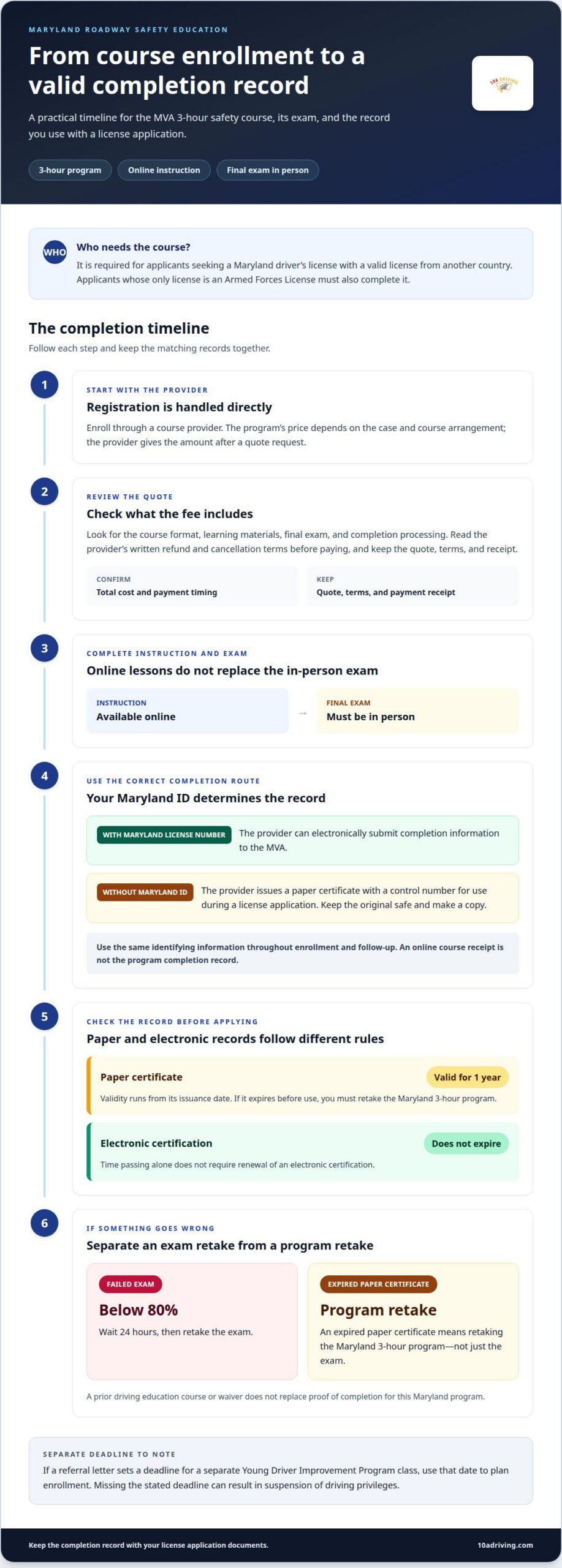
For the MVA 3-hour safety course in Maryland, completion is recorded through the provider’s electronic submission or a paper certificate. The route depends on the learner’s Maryland identification details. Keep the course record with your license application documents, and use the same identifying information throughout enrollment and follow-up.
Identification and Completion Documents
With a Maryland driver’s license number, the provider can electronically submit completion information to the MVA. Without a Maryland ID, the provider issues a certificate with a control number for use during a license application. Keep that certificate in a safe place and make a copy for your records. When preparing your application, compare the certificate details with your paperwork so you can present the right completion record.
If you’re waiting for your course record to be reflected in your next step, first identify which completion route applies to you. A student using electronic submission should provide the Maryland license number needed for that record. A student relying on paper should retain the control-number certificate. These are distinct documentation paths, so don’t treat an online course receipt as the same item as the program’s completion record.
Duration and Completion Requirements
The MVA 3-hour safety course in Maryland is also referred to as an alcohol and drug education program. The course is available online, while its final exam must be completed in person. Treat instruction format and completion documentation as separate matters: completing online lessons does not replace the required exam or the record used to document completion.
After finishing, keep the relevant record with your application materials. If a referral letter sets a deadline for a separate Young Driver Improvement Program class, use that date to plan enrollment. Missing the stated deadline can result in suspension of driving privileges, so keep the referral letter accessible while arranging that class.
Certificate validity and retaking the program
Maryland uses different validity rules for paper and electronic completion records. A paper certificate for the 3-Hour Roadway Safety Education Program is valid for 1 year from its issuance date. Electronic certifications do not expire. Keep the certificate type in mind when planning a license application, because an expired paper document requires another step.
If you receive a paper certificate, note its issuance date and keep the original available for your application. If the certificate expires before you use it, you must retake the Maryland 3-hour program. An electronic certification has no expiration, so it does not require renewal solely because time has passed.
Failing the final exam is different from having an expired certificate. Students who fail must wait 24 hours before retaking the exam. A score below 80% requires returning after that waiting period and retaking the test. This rule applies to the exam, while an expired paper certificate requires retaking the program itself.
A waiver or transfer credit should not be treated as a substitute for completing Maryland’s program. A prior driving education course does not provide proof of completion for this specific requirement. Use the certificate or electronic certification connected to the Maryland program when documenting completion.
For example, a driver who passes and receives a paper certificate should compare its issuance date with the planned license application. If that certificate has expired, the driver must retake the program. A driver who fails the exam instead waits 24 hours, then retakes the exam. These are separate situations, so identify whether the issue is an unsuccessful test or an expired document.
Before applying, locate the completion record and identify whether it is paper or electronic. That simple check helps a Maryland driver determine whether the certificate remains valid or the program must be repeated.
Course cost and refunds
The Maryland roadway safety driving program has a provider-set fee. The amount depends on the case and is given after a quote request. Compare what the fee covers, such as instruction, the final exam, and completion processing. These details help you understand the quoted amount rather than comparing prices without knowing which services are included.
Before enrolling, ask for the total cost and payment timing in writing. Confirm whether payment is due before instruction, after the exam, or at another stated step. The course fee is paid directly to the program provider. Keep the quote and payment receipt together so you can refer to the agreed amount and payment record.
Refund terms are separate from the course fee. Read the provider’s written terms before paying, especially the rules for cancelling, missing a class, or not passing the exam. Save a copy of those terms with your receipt. For example, if your schedule changes before you attend, the written cancellation terms clarify what options apply.
Review the fee and payment details before you register. Use this sequence:
- Request a quote for the specific roadway safety education program.
- Review what instruction, exam, and completion services the amount includes.
- Read the refund and cancellation terms before submitting payment.
- Save the quote, terms, and receipt for your records.
These steps help distinguish the course charge from any separate service or process. If the quote does not explain a listed charge, ask the program provider to clarify it before paying. Keep your records until you have completed the class and received confirmation of completion. That gives you a clear record of the price agreed, the terms accepted, and the payment made.
Course price and included services
Compare a course quote by looking at both instruction and completion services. The price depends on the case and is given after a quote request. Relevant factors include the course format, learning materials, final exam, and how completion information is processed. A driving school’s listed total is easier to assess when these items are clearly identified.
The Maryland 3-Hour Roadway Safety Education Program may include online slides, a final exam, and electronic filing of completion with the MVA. Treat these as separate parts of the course package: slides provide the instruction, the exam assesses learning, and electronic filing records completion. Ask how the provider handles each item before enrolling, especially whether electronic reporting is part of the quoted service.
Use this checklist to compare course details:
- Identify whether instruction is online or delivered in person.
- Confirm that the final exam is included in the course arrangement.
- Find out whether completion is filed electronically with the MVA.
- Review what document you receive after completing the program.
These details matter because a low headline figure may not describe the full process. For example, a course with online slides still requires you to understand how its exam and completion record are handled. Electronic filing can reduce a separate paperwork step, while a paper certificate may require you to keep and present that document. Compare the complete service, not just the instruction format.
For enrollment, review the roadway safety course details and note which included services match your needs. The clearest choice is the program that explains its learning materials, exam process, and completion record together, so you know what the quoted fee covers before you attend.
10A Driving School Silver Spring: Driver’s Education
10A Driving School Silver Spring offers 3-Hour Road Way Safety for learners completing Maryland’s roadway safety education requirement. Turn to this program when you need the course itself; choose Driver’s Education for broader driving instruction. If you’ve been referred to a Driver Improvement Program, that offering addresses a different need. Extra Practice/Personal Practice supports learners seeking additional driving practice.
Match the service to your immediate goal: complete the roadway safety program, build driving skills through driver education, or address a Driver Improvement Program requirement. These programs serve different purposes, so identify the requirement or learning need you’re addressing before selecting one.
Visit 10A Driving School Silver Spring to learn more about its driving education services.
Choose the next step for your driving goals
Use what you’ve learned to decide what matters next: completing the required course, addressing a separate MVA program, or building confidence behind the wheel. Choose the goal that fits your current situation, then plan one practical step toward it.
10A Driving School Silver Spring can help you identify the relevant instruction for your driving goal. Review the available information and decide whether its programs align with the next step you need to take.
For guidance on moving forward, contact 10A Driving School Silver Spring. Take the next step at a pace that supports safe, responsible driving.
Frequently Asked Questions
How do I register?
Start with the provider’s enrollment process, then keep the registration record with your course information. For 10A Driving School Silver Spring, enrollment is through the school’s website. Once registered, use the provider’s course instructions to prepare for the scheduled class and exam. Keep course enrollment separate from your Maryland license application, which has its own steps.
What am I required to bring to the class?
Bring the identification and supporting documents relevant to your situation. If you’re converting a foreign license, keep your course paperwork together with the documents you’ll use for the wider Maryland licensing process. That process also includes a vision screening, knowledge test, and Maryland road test at the MVA. Organizing these separately helps prevent course completion paperwork from being confused with test requirements.
What is the cost of the program, and are there any refunds?
The provider sets the course fee, and refund terms depend on its enrollment policy. Before registering, read the cancellation terms alongside the payment instructions. Note what applies if you withdraw, miss the scheduled class, or need to change your enrollment. Keep the policy and payment record together so you can refer to the terms that applied when you signed up.
Who is required to take the Maryland 3-hour safety course?
The course applies to qualifying applicants seeking a Maryland license with a valid license from another country, including applicants whose only license is an Armed Forces License. Applicants with licenses from another U.S. state, a U.S. territory, Canada, or Yukon are exempt. This distinction concerns the issuing jurisdiction, not how long someone has held a license.
Where can I take an MVA-approved 3-hour course in Maryland?
Choose a provider that offers Maryland’s Roadway Safety Education Program. The instruction may be online, while the required final exam is in person. This distinction matters when planning attendance: completing online lessons does not mean every course step happens remotely. Confirm your selected class arrangement and exam instructions as part of enrollment.
How do I register for the Maryland 3-hour course?
Contact a program provider directly to enroll. If you’re registering with 10A Driving School Silver Spring, use the school’s online enrollment process and select the roadway safety program. Keep the enrollment confirmation and course instructions accessible. This second registration question concerns the specific Maryland program, while the general registration question covers the provider’s enrollment process overall.

