

Passing a road test starts well before test day. In Maryland, Driver’s Education requires 36 hours, and preparing also means building practical skills through guided instruction and practice. For learners looking for the best driving school in Silver Spring, a good fit is one that explains the learning process clearly and supports steady skill development.
It’s reasonable to want to know what happens in class, what you’ll practice behind the wheel, and how instructors help you prepare. This guide explains those parts, what to expect from instructors, and how course pricing depends on the instruction needed, lesson format, and additional practice, with pricing provided after a quote request. It also covers how extra fees can affect the overall cost, so you can understand the full learning plan.
Use the details ahead to understand the path from classroom learning to practical preparation and make an informed choice for driving in Silver Spring.
Key Takeaways
- Understand how behind-the-wheel practice builds useful driving skills and supports preparation for a road test.
- Learn what Maryland’s 36-hour Driver’s Education requirement means for classroom learning.
- See which factors can affect course costs and additional fees, so you can better understand the overall expense.
- Know what to look for in an instructor’s qualifications, teaching approach, and guidance.
Behind-the-wheel instruction
Maryland’s licensing path moves from a learner’s permit to supervised driving, then to a provisional license. Drivers must meet the conditions for each stage before moving on, including permit eligibility, supervised-driving requirements, and provisional-license eligibility.
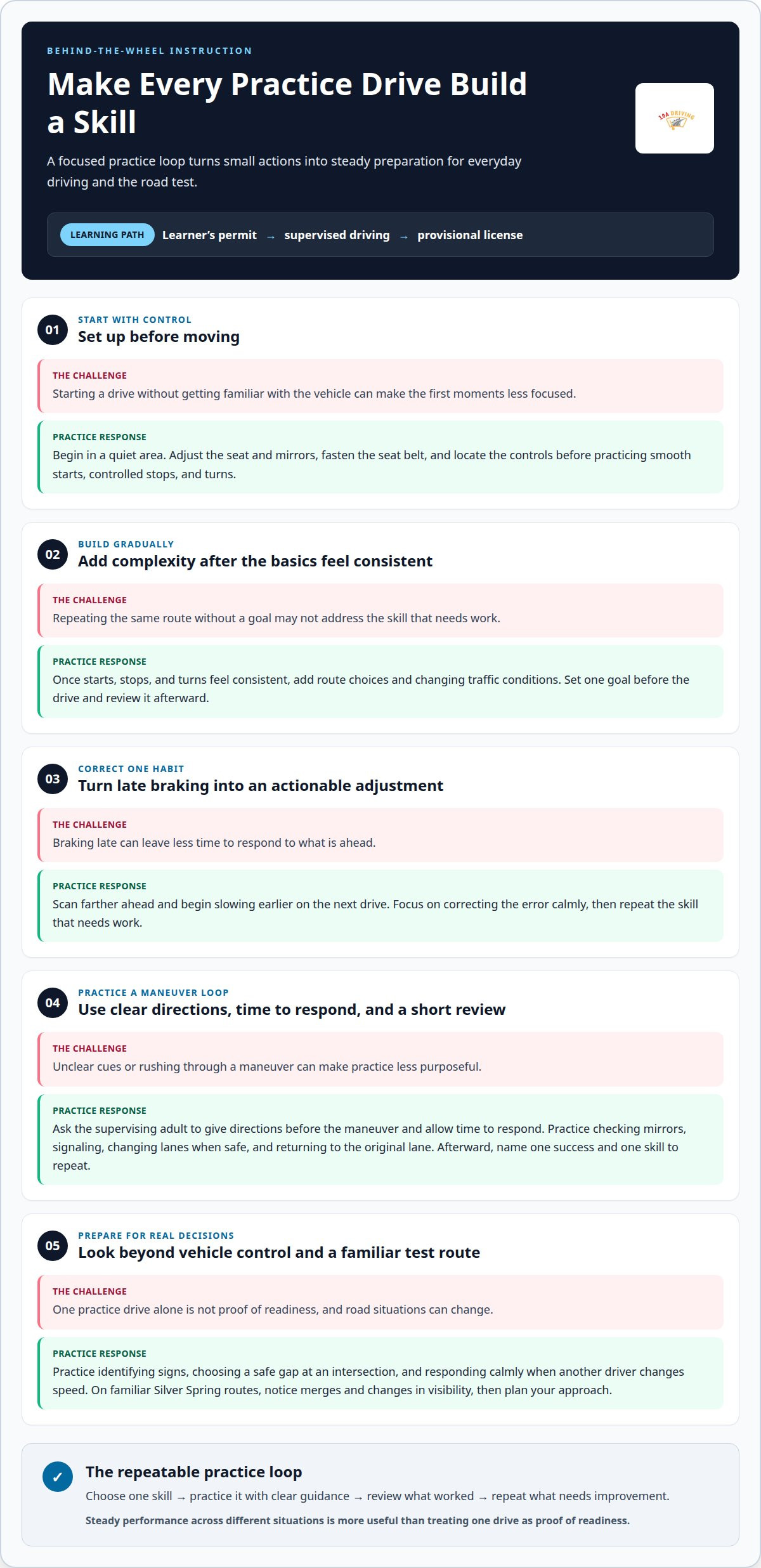
Use each practice drive to build one skill at a time. Begin in a quiet area by adjusting the seat and mirrors, fastening the seat belt, and locating the vehicle’s controls. Then practice smooth starts, controlled stops, and turns. Once those actions feel consistent, add route choices and changing traffic conditions. For example, if you brake late, scan farther ahead and begin slowing earlier on the next drive.
Ask the supervising adult to give clear directions before a maneuver, then allow time to respond. A useful practice loop might include checking mirrors, signaling, changing lanes when safe, and returning to the original lane. Afterward, discuss one successful action and one skill to repeat. This makes the next drive purposeful instead of repeating the same route without a goal.
Road-test preparation should include everyday decisions, not just vehicle control. Practice identifying signs, choosing a safe gap at an intersection, and responding calmly when another driver changes speed. On a familiar Silver Spring route, notice where traffic merges or visibility changes, then plan how to approach those points. Don’t treat one practice drive as proof of readiness. Steady performance across different situations is more useful.
In-car instruction helps learners apply classroom concepts to real situations. Focus on safe observation, predictable control, and correcting errors calmly. Set a goal before driving, review it afterward, and repeat the skill that needs work. This step-by-step approach builds habits learners can use beyond a test route.
Classroom instruction
Classroom learning gives new drivers time to understand road rules and consider decisions before applying them behind the wheel. Choosing the best driving school in Silver Spring means looking for instruction that connects each topic to practical driving situations.
Useful study goes beyond memorizing signs. Consider how attention, space, and communication affect a trip. For example, discussing following distance can show why drivers should leave more room when road conditions reduce visibility. An intersection scenario can help learners identify what to observe before deciding whether a turn is safe.
Make each review session active:
- Road signs: Explain what a sign means and imagine where it might appear on a local drive.
- Hazards: Identify a risk, such as a parked vehicle blocking a view, and decide what to observe.
- Driving choices: Compare responses to a situation, such as slowing when traffic ahead stops.
- Vehicle readiness: Review how seat belts, mirrors, and clear visibility support safer driving.
After a lesson, write down one concept and a situation where it applies. Use that note to prepare a question for the next class. This helps connect classroom topics with decisions on the road.
Classroom lessons can also make space for questions and practical examples; driver education information can help you understand how this learning fits into preparation.
Classroom discussions can also clarify how licensing milestones shape a learner’s preparation. In Arizona, a person must be at least 15½ years old to get a Graduated Instruction Permit. In Arizona, a person must be at least 18 years old to receive a full Class D Operator License.
Reviewing licensing requirements alongside road topics gives learners a chance to ask questions and connect instruction with the steps they are working toward. Focus on understanding the rules and applying classroom concepts thoughtfully during practice.
Course price and additional fees
Compare the full learning plan, not just the first figure shown. A clear breakdown helps distinguish included instruction from optional additions.
Course Pricing
The price depends on the learner’s needs and is provided after a quote request; factors include course format, included instruction, and additional practice. Compare what each quoted amount covers, such as classroom learning, behind-the-wheel lessons, and any planned practice beyond the core course. For example, two plans may differ because one includes more instruction or a different lesson format. A lower starting figure may not represent the full plan.
Read the course details as a complete outline. Identify the instruction included, how lessons are arranged, and whether the plan suits the learner’s experience. These details matter more than comparing headline amounts alone. If a learner needs extra practice, consider how it fits into the learning plan.
Additional Fees
Review any separate charges alongside the course amount. Look for line items explaining whether extra practice, learning materials, schedule changes, or other services add to the total. These are categories to understand in a price breakdown, not a claim that every course charges them. An itemized breakdown makes it easier to see what is included and what is optional.
If a learner is considering additional practice, compare its purpose and place in the instruction plan. Separate required learning from optional support, then calculate the total for the selected plan. Don’t assume a possible extra is a fixed fee without reviewing how it applies.
Use a simple comparison method: note the course format, included instruction, optional additions, and total cost. Check that each plan is compared on the same basis, rather than comparing a full program with a partial course. In Silver Spring, the learner’s needs and selected instruction shape the learning plan. A clear breakdown helps families plan without assuming every student needs the same additions.
Instructor qualifications and experience
An instructor’s credentials and teaching approach both matter. Look for clear explanations, patient corrections, and lessons that connect driving knowledge with practical decisions.
Instructor Credentials
Credential details help you understand an instructor’s training background. Cynthia Roman says she has been a Maryland-certified instructor since 2006. Melvi Howard Bell says she has been a certified instructor since 2002. These stated qualifications provide useful context, alongside how each instructor explains rules and responds to learner questions.
During a lesson, notice whether instructions are specific and timely. Before a turn, for example, an instructor can explain what to observe, then offer focused feedback afterward. Clear corrections identify what to change, such as checking a mirror earlier, rather than simply saying a maneuver was wrong. This gives learners something concrete to practice.
Instructor Experience
Experience can shape how an instructor handles different learning needs. Wendy Wilmore says she has been an instructor for 10 years. That figure describes her stated time as an instructor; it does not by itself show how a lesson is taught. Consider whether explanations match your current skills and whether feedback helps you understand the next step.
Look for instruction that adapts to the learner’s progress. A beginner may need a slower explanation of vehicle controls, while a more practiced learner may benefit from detailed feedback on observation or lane positioning. In either case, a useful lesson has a clear objective, calm direction, and time to apply corrections.
Use a first lesson to observe how feedback is delivered. Note whether the instructor explains the reason behind a correction and gives you a chance to try again. Those details can help you decide whether the teaching style supports your learning. To explore driver education instruction, review the available learning information.
10A Driving School Silver Spring: Driver’s Education
10A Driving School Silver Spring offers Driver’s Education for learners seeking structured instruction in Maryland. It also provides Extra Practice/Personal Practice for learners who want additional time to build practical skills.
Choose the offering that matches your current need. Driver’s Education supports learners beginning their training, while Extra Practice/Personal Practice can suit someone who wants more practice with specific skills. The Driver Improvement Program and 3-Hour Road Way Safety are separate options for different learning needs.
Use the classroom and behind-the-wheel details above to identify which type of instruction fits your next step. For information about training options, visit 10A Driving School.
Take the Next Step Toward Confident Driving
Set a clear learning goal before choosing your next step. A new driver may need a structured foundation, while someone with driving experience may want focused instruction or help strengthening specific skills. Finding the best driving school in Silver Spring means matching the learning plan to that goal and giving each skill time to develop.
10A Driving School Silver Spring offers Driver’s Education, Driver Improvement Program, and Extra Practice/Personal Practice. Each supports a different learning need, so consider whether you’re beginning driver education, pursuing improvement, or looking for more practice. A focused plan makes it easier to move forward with purpose and build habits that carry into everyday driving.
Choose the learning path that fits your current priorities, then take a practical next step. Contact 10A Driving School Silver Spring to discuss driver education options. With steady practice and clear goals, you can continue building confidence one decision at a time.
Frequently Asked Questions
How to prepare for driving test?
Prepare by practicing the skills you find hardest, then review the MVA test-day requirements. Bring your learner’s permit and signed skills log. The test vehicle must be operationally sound, safe, clean, insured, and registered. If a supervising driver accompanies you, that person must be at least 21 and hold a valid driver’s license. A checklist can help you organize these items before leaving home.
How much do driving lessons and packages cost in Silver Spring?
Course pricing depends on the selected program, lesson format, and whether you need extra practice; the price is provided after a quote request. Tuition is paid in three installments: one-third at registration, one-third at the end of the first week, and the final third before the final exam. Payment is accepted online, by phone, in person, or by check. Compare the full plan, not only its starting cost.
Which schools offer Maryland driver’s education courses and the required 30 classroom and 6 behind-the-wheel hours?
Maryland Driver’s Education totals 36 hours, split into 30 classroom hours and 6 behind-the-wheel hours. 10A Driving School offers this MVA-approved course. Its classroom schedule is 10 days at 3 hours per day, while in-car training is arranged over 3 days, with 2 hours per appointment. Learners in Silver Spring, Burtonsville, Colesville, Beltsville, Hyattsville, Kensington, Rockville, and Bethesda can consider this local option.
What do recent students say about instructor quality and pass rates at local schools?
Use student feedback to look for specific teaching examples, such as clear explanations, useful corrections, and respectful communication, rather than relying on a pass-rate claim alone. 10A Driving School’s instructors are Maryland MVA-certified. Certification describes instructor credentials, not an individual student’s result. For learners in Silver Spring, a practical measure of fit is whether instruction addresses the skills they need to develop.

