

An unsafe action can end your Maryland road test immediately. To schedule a road test at the MVA, you need a valid, unexpired learner’s permit, and appointments are required for behind-the-wheel tests. Moving a cone or flag on the closed course or failing to stop completely at a stop sign can cause automatic failure.
It’s natural to focus on the maneuvers you’ll be tested on, but safe, consistent driving matters throughout the test. This guide explains how to schedule your appointment, prepare your documents and vehicle, and practise the skills the test assesses. You’ll also learn what can cause an immediate failure and how the test moves from the closed course to public roads. Use these steps to prepare calmly, arrive ready, and show the examiner that you can control the vehicle and make safe decisions.
Key Takeaways
- Bring the required documents and use a vehicle that meets the test requirements to reduce the risk of a canceled appointment.
- Practise the closed-course maneuvers and public-road driving skills the examiner assesses.
- Use mirrors and head checks when reversing, even if the vehicle has a backup camera.
- Build confidence with focused driving practice before test day, especially on the skills that need more consistency.
Scheduling an MVA road test
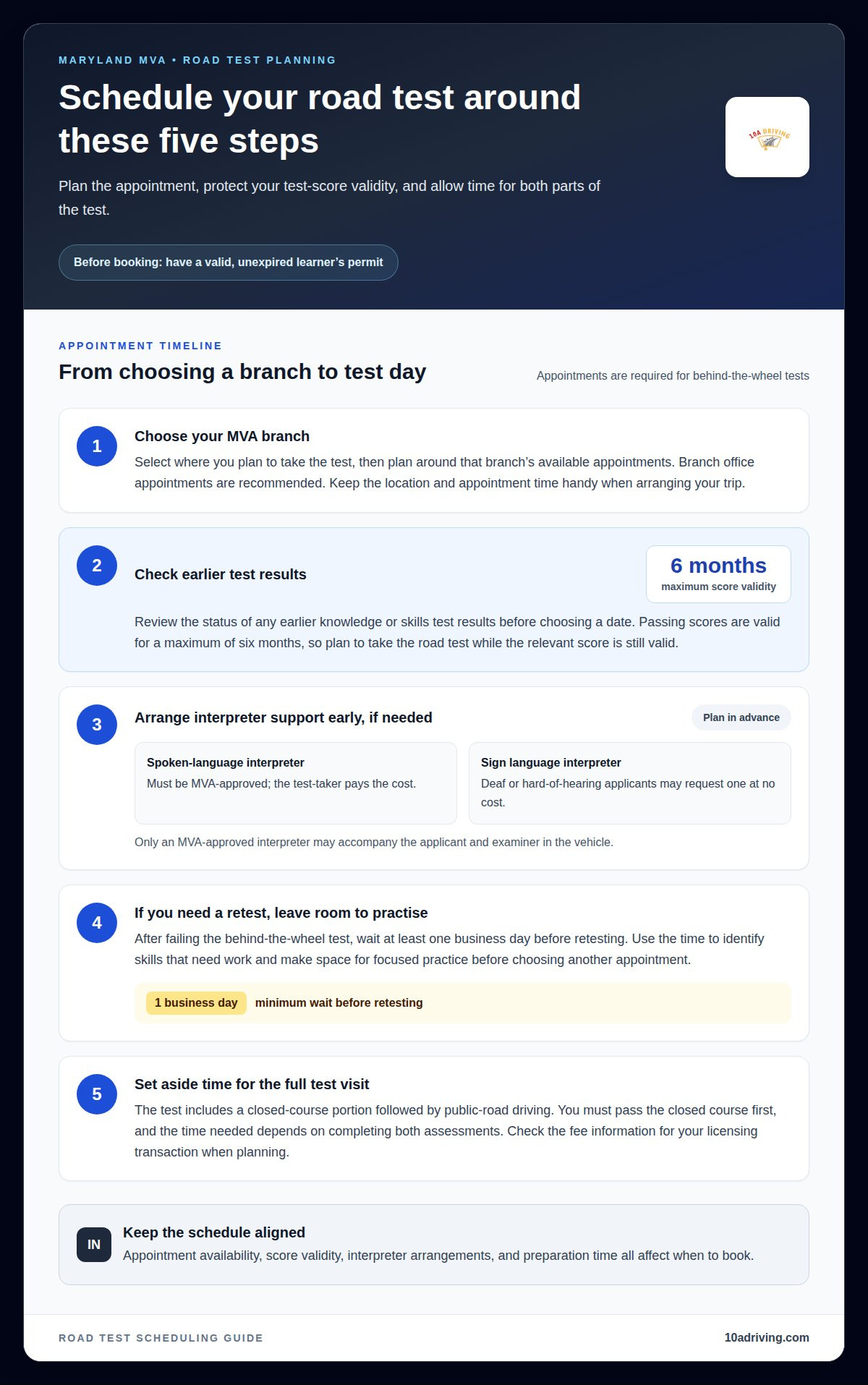
- Choose the Maryland MVA branch where you plan to take your test, then plan around its available appointments. Branch office appointments are recommended. Keep the appointment details handy so you can refer to the location and time when arranging your trip.
- Review the status of any earlier knowledge or skills test results before setting a date. According to the Maryland Motor Vehicle Administration, passing scores are valid for a maximum of six months. Plan the appointment so the relevant passing score remains valid when you take the test.
- If you fail the behind-the-wheel test, wait at least one business day before retesting. Use that time to identify the skills that need more work, then choose a new appointment that leaves room for focused practice. A retest is an opportunity to address specific gaps, not simply repeat the same preparation.
- Arrange communication support in advance if you need an interpreter. Maryland permits approved spoken-language interpreters for behind-the-wheel tests at the test-taker’s expense. Deaf or hard-of-hearing applicants may request a sign language interpreter at no cost. Only an MVA-approved interpreter may accompany the applicant and examiner in the vehicle.
- Set aside time for the full test visit rather than planning around an exact driving duration. Maryland’s behind-the-wheel test includes a closed-course portion and public-road driving, and you must pass the closed course first. The time needed depends on completing both assessments. Consult the fee information for your licensing transaction when planning the appointment.
The Maryland Motor Vehicle Administration states that Maryland knowledge and skills test passing scores are valid for a maximum of six (6) months. Use this validity period as a scheduling constraint, leaving enough time to secure an appointment and complete any needed preparation before the score expires.
Automatic-failure actions
During a Maryland behind-the-wheel test, an unsafe action stops the test immediately. Treat every maneuver as a safety decision, not merely a demonstration of vehicle control. Follow these steps to avoid documented failure triggers and maintain safe driving throughout.
- Approach each stop sign with enough control to stop completely. Bring the vehicle to a full stop before moving again. A rolling stop can cause automatic failure, even if the intersection appears clear. Pause, assess the road, and proceed only when it’s safe.
- Avoid cones and flags during the closed-course portion. Keep the vehicle clear of course markers while turning, reversing, and positioning. Moving a cone or flag can cause automatic failure. Slow down when a maneuver feels tight, and make small corrections instead of rushing.
- Choose safety over continuing a maneuver when conditions change. Maryland’s test stops immediately if you do anything unsafe. For example, don’t enter another road user’s path just to complete a turn. Wait until it’s safe to continue and follow the examiner’s directions.
- Manage your speed and space before each action. Look ahead for signs, course markers, pedestrians, and traffic. Slow down early before a turn or obstacle. Leave enough room to steer without striking a cone or flag, and avoid sudden movements that could make the vehicle unsafe.
- Practise the same controlled habits before test day. Rehearse complete stops and careful movement around markers until your actions become consistent. If a specific maneuver remains difficult, use focused driving practice to work on vehicle control and safer decisions. Reliable routines help you respond deliberately under test conditions.
Behind-the-wheel test vehicle and document requirements
- Arrange for a licensed driver to take you to the Maryland test location. That driver must remain behind the wheel until the examiner checks their license. Plan this handoff before leaving, and make sure the driver stays with the vehicle through the initial check. Don’t expect to drive yourself to the test site.
- Prepare the vehicle before setting out. Maryland’s behind-the-wheel test vehicle must have at least half a tank of gas. Check the fuel level early enough to refuel if needed. This simple step can prevent an avoidable problem at the test location and ensure the vehicle is ready for the appointment.
- Gather the required documents before you travel. A Maryland behind-the-wheel test may be canceled if required documents are missing. Use the appointment instructions to organize your paperwork. Keep the documents together and within easy reach, rather than searching through bags or compartments at check-in.
- Before leaving, make a brief check with your accompanying driver. Confirm that the vehicle has enough fuel and that you have the required paperwork. Keep the driver available until the examiner checks their license. These steps address key arrival requirements and reduce the chance that incomplete preparation disrupts your test.
- Separate arrival arrangements from driving practice. The licensed driver takes you to the test location and remains behind the wheel for the license check. Afterward, follow the examiner’s directions. If a document is missing or the vehicle has less than half a tank, resolve the issue before attempting the test.
Test preparation and driving practice
- Prepare for every part of the Maryland test: a pre-trip inspection, basic vehicle control on a closed course, and general driving skills on public roads. Practise checking the vehicle before moving, controlling it at low speed, and responding smoothly to traffic. The test assesses more than a single maneuver.
- Practise the reverse two-point turnabout until each movement feels deliberate. Maryland requires this maneuver to be completed within three minutes. Work on positioning the vehicle, reversing under control, and checking your surroundings throughout. Follow a clear sequence instead of rushing to beat the time limit.
- Use every available view while reversing. Maryland test-takers may use backup cameras, but must still check mirrors and perform head checks. Practise shifting your attention among the camera, mirrors, and direct observation. A camera adds another view; it does not replace looking around the vehicle.
- Build public-road judgment into your driving practice. Each Maryland MVA has a preset route for the public-road portion, so prepare for everyday decisions rather than memorizing a path. At an all-way stop, the vehicle that arrived first goes first; when vehicles arrive together, the vehicle on the right goes first. Practise scanning for signs and other road users.
- Turn practice into a repeatable routine. Work on steering control, observation, stops, turns, and lane changes, then identify which skill needs more attention. If you need guided time behind the wheel, schedule Extra Practice/Personal Practice to strengthen specific driving skills before test day.
On the Bel Air MVA route, drivers may need to stop completely before the stop line, then pull forward for a better view; traffic may require a second stop. Drivers should slow down before passing a lane obstruction; if the lane is blocked and no oncoming traffic is present, drivers may cross the yellow line. For the right turn onto S. Atwood Road, drivers should approach in the center of the lane; a staggered stop may be needed.
At the light across Baltimore Pike, follow the yellow line into the left lane, which is used for turning left or continuing straight. The examiner may ask you to change lanes to the right and then return to the left.
10A Driving School Silver Spring: 3-Hour Road Way Safety
10A Driving School Silver Spring offers 3-Hour Road Way Safety for learners who need this course as part of their preparation. Out-of-country license holders taking Maryland’s behind-the-wheel test must present a 3-hour Roadway Safety course certificate. The course can therefore be a relevant step for applicants in that situation.
Driver’s Education helps you learn driving fundamentals, while Extra Practice/Personal Practice gives you more time to work on specific skills. The Driver Improvement Program is for drivers who need that program. Choose the option that matches your learning needs or course requirement, rather than treating every service as road-test preparation.
Contact 10A Driving School Silver Spring to discuss the relevant learning option for your needs.
Make your next step purposeful
Preparing for your road test at the MVA is also a chance to build habits that continue after test day. Choose support that fits your current stage: foundational instruction, focused practice, or a program for drivers who need improvement. A steady plan helps turn individual skills into consistent decisions on the road.
10A Driving School Silver Spring offers Driver’s Education, Driver Improvement Program, and Extra Practice/Personal Practice. These options support different learning needs, from developing core skills to practising specific areas behind the wheel. Select the kind of support that matches what you want to work on next.
Explore driving education and practice options, then continue preparing with focus. Each deliberate practice session can help you approach your next drive with greater control and confidence.
Frequently Asked Questions
Are there any actions that would cause automatic failure during the test?
Yes. Any unsafe action can stop the test immediately. If you fail, you must wait at least one business day before retesting. Use the time before your next appointment to work on the skills that contributed to the result.
Can I use a backup camera during the test?
Yes. A backup camera is allowed as an additional view, but it doesn’t replace mirrors or head checks. Practise coordinating all three so the screen doesn’t distract you from observing the area around the vehicle.
Do I have to have a licensed driver with me at my behind-the-wheel test?
Yes. A licensed driver must take you to the test location and remain behind the wheel until the examiner checks their license. After that check, an MVA-approved interpreter is the only additional person permitted in the vehicle besides the applicant and examiner.
What if I forget to bring my learner’s permit to my skills test?
The test may be canceled if required documents are missing, so bring your permit with your appointment materials. If you realize it’s missing before leaving, retrieve it rather than arriving without it. A canceled appointment means you’ll need to arrange another test time.
How do I schedule a road test at the MVA?
Book through Maryland’s MVA appointment process and select a branch office and available time. Branch office appointments are recommended. Before choosing a date, consider whether any passing knowledge or skills test result will still be valid on test day.
What documents do I need for an MVA road test?
Bring your learner’s permit and any documents required for your appointment. Applicants with an out-of-country license must also present a 3-hour Roadway Safety course certificate. Keep these papers together so they’re easy to present during check-in.

