

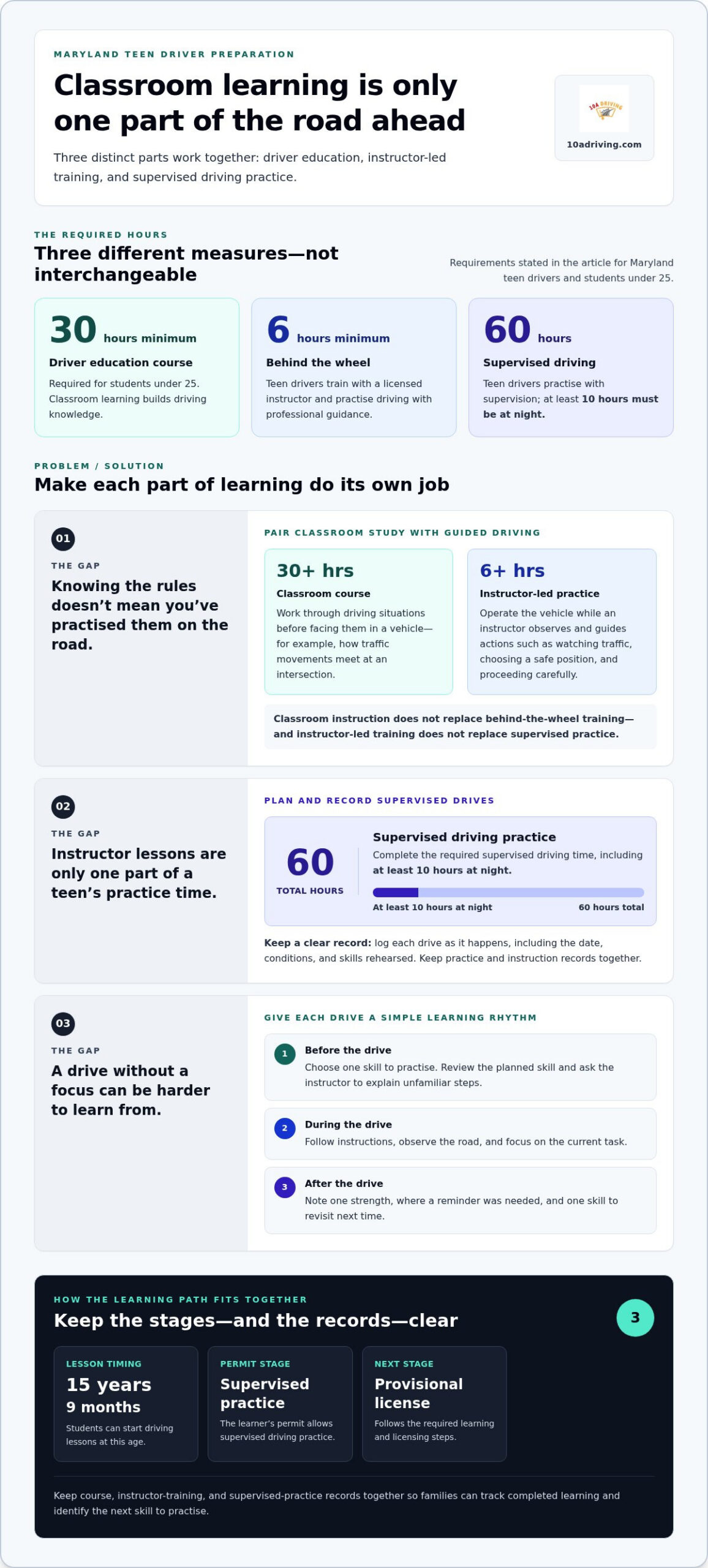
For families considering driver education in Silver Spring, Maryland, students under 25 must complete a driver’s education course of at least 30 hours, according to the Maryland Motor Vehicle Administration. Teen drivers must also complete at least 6 hours of behind-the-wheel training with a licensed instructor. Together, these requirements make driver education a combination of classroom learning and practical instruction.
Understanding how the parts fit together makes driver education in Silver Spring more effective: lessons build knowledge, while supervised practice helps new drivers apply it on the road. Classroom instruction does not replace practice, and instructor-led training is one part of the learning process.
This guide explains what Maryland requires, how classroom and road training work together, and where instruction is available in Silver Spring. It also covers the supervised practice expectations: according to the Maryland Motor Vehicle Administration, teen drivers must complete 60 hours of supervised driving, including at least 10 hours at night. With these steps in view, learners and families can better understand the path ahead.
Key Takeaways
- Understand how classroom lessons and behind-the-wheel instruction build different parts of a learner’s driving knowledge and skills.
- Plan supervised practice as a separate part of learning, and keep a clear record of the required driving time.
- See how Maryland’s driver education course fits into the process and what classroom instruction is designed to teach.
- Identify whether driver education, extra practice, or another relevant course best matches your next learning step.
Classroom and behind-the-wheel training
How many classroom and behind-the-wheel hours are required in Maryland driver education? Students under 25 must complete at least 30 hours of driver education, according to the Maryland Motor Vehicle Administration. Teen drivers must also complete at least 6 hours of behind-the-wheel training with a licensed instructor.
Classroom study and road instruction serve different purposes. In class, learners build understanding before applying that knowledge in a vehicle. Instructor-led training gives them a chance to practise driving with professional guidance. Neither replaces the other.
Use classroom time to work through driving situations before facing them on the road. For example, discuss how to respond when several traffic movements meet at an intersection. In the car, an instructor can guide the learner in observing traffic, choosing a safe position, and proceeding carefully.
Behind-the-wheel instruction is practical and focused. The learner operates the vehicle while the instructor observes and gives guidance. A session might focus on steering smoothly through a turn, then progress to handling several tasks at once.
Make each drive purposeful. Before setting off, choose one skill to practise. Afterward, note where the learner needed a reminder and what felt more controlled. This brief review connects classroom knowledge with actions behind the wheel.
- Before the drive: Review the planned skill and ask the instructor to explain unfamiliar steps.
- During the drive: Follow instructions, observe the road, and focus on the current task.
- After the drive: Recall one strength and one skill to revisit next time.
For families planning driver education in Silver Spring, keep classroom coursework and instructor-led practice on the same learning path. The 30-hour course and 6-hour instructor requirement provide distinct measures; supervised practice adds another part of a teen’s preparation. Track completed instruction and identify the next skill to practise, so each learning step has a clear purpose.
Driving instruction in Silver Spring and Montgomery County
Teen drivers in Silver Spring must complete 60 hours of supervised driving practice, according to the Maryland Motor Vehicle Administration. At least 10 hours must take place at night, also according to the Maryland Motor Vehicle Administration. Record practice as it happens, including the date, conditions, and skills rehearsed.
Maryland’s teen licensing process includes a learner’s permit stage followed by a provisional license stage. The permit allows supervised practice; the provisional stage comes after the required learning and licensing steps. Keep instruction and practice records together so families can track progress.
Students can start driving lessons at 15 years and 9 months. This is the minimum starting age stated for lessons, not a substitute for understanding the separate permit and provisional license stages. Plan lesson timing around the learner’s readiness and the supervised practice still needed.
Instructor experience can help families understand who will guide lessons. Wendy Wilmore said she had 10 years of experience as an instructor. Cynthia Roman has been a Maryland-certified instructor since 2006, and Melvi Howard Bell has been a certified instructor since 2002. These named examples offer context when considering instruction in the area.
For local school locations and contact details, use the school’s own current information to identify its Silver Spring location and the appropriate way to arrange instruction. Keep the location and contact details together with the learner’s schedule, especially when coordinating classroom study, road lessons, and supervised practice.
Financial assistance or low-cost options in Montgomery County depend on eligibility and program requirements. When planning instruction, distinguish the required driver education course from optional extra practice.
To explore local instruction options, consider which learning step comes next: structured lessons, additional practice, or continued supervised driving.
Maryland driver’s education course
In Silver Spring, available instruction includes a Maryland driver’s education course and a Driver Improvement Program. The right starting point depends on the learner’s purpose: building foundational knowledge or improving existing driving skills. Drivers referred to a DIP can learn more about a court-ordered driving class in Silver Spring, MD and how to identify the required course.
Students under 25 in Silver Spring must take a driver’s education course of at least 30 hours, according to the Maryland Motor Vehicle Administration. Treat that course as a structured part of learning, distinct from supervised practice and instructor-led road training. Keep course records with other learning documents so each requirement stays easy to track.
Make classroom learning easier to use by organizing notes by topic instead of copying every detail. Create separate entries for signs, intersections, and decisions that require careful observation. Write down questions as they arise and revisit them before moving on. This approach breaks a long course into manageable steps.
Families can support learning by setting a regular study routine and reviewing progress together. After a lesson, ask the student to explain one idea in their own words. A clear explanation can reveal what they understand and which topics need another look. Keep the discussion focused on learning, not memorizing answers without context.
- Before a session: Gather course materials and choose a topic to review.
- During study: Record questions and connect each idea to a driving example.
- After study: Summarize one concept and mark anything that needs another review.
A Driver Improvement Program has a different purpose from initial driver education: it focuses on improvement rather than introducing a new learner to the full process. Consider the learner’s experience and reason for seeking instruction before choosing a course. Someone just starting out needs foundational education; an experienced driver may be looking to improve specific skills. Matching the course to the goal keeps learning focused and practical.
Classroom instruction
Classroom instruction helps learners examine driving decisions before handling them on the road. In Maryland, drivers with an out-of-country license applying for a Maryland license must complete a 3-hour roadway safety education program. The program gives this group a focused classroom step within the licensing process.
Connect rules with clear examples during study. For instance, consider how a driver should respond when approaching an intersection with traffic moving in several directions. Identify the relevant information, then explain the decision in plain language. This builds understanding instead of relying only on memorized terms.
Use a simple three-step classroom routine. First, review the topic and note unfamiliar terms. Next, work through each example and write down questions. Finally, summarize the key point without looking at your notes. This helps learners spot gaps before moving on.
- Sort notes by topic: Keep information about signs, intersections, and road decisions together.
- Use a practical example: Describe what a driver observes and how that observation informs a decision.
- Review open questions: Return to unclear points before ending the study session.
For an out-of-country driver completing Maryland’s 3-hour program, set aside focused time for each part of the material. A simple checklist can track topics reviewed, questions raised, and ideas that need another pass. This keeps the session organized without adding unsupported requirements to the program.
Classroom learning is more useful when learners can explain a decision and connect it to a road situation. After studying an example, ask what the driver noticed, what choice followed, and why it made sense. These prompts bridge study and later driving practice.
For structured instruction related to the roadway safety program, explore roadway safety education as a next step.
10A Driving School Silver Spring: Driver’s Education
10A Driving School Silver Spring offers MVA-certified training for learners who need structured driver education or focused support with driving skills. Its Driver’s Education suits students beginning their learning process, while Extra Practice/Personal Practice can help learners who want additional time to work on specific skills.
Drivers seeking instruction for a different purpose can consider the Driver Improvement Program or 3-Hour Road Way Safety. Choose the offering that matches your current learning need, whether that means foundational education, extra practice, improvement instruction, or roadway safety education.
For instruction that fits your next step, contact 10A Driving School Silver Spring or visit 10adriving.com.
Choose a clear next step
Learning becomes more purposeful when the next goal is specific. Rather than trying to improve everything at once, choose one skill or decision to focus on during the next session. A brief note afterward can help identify what to practise next.
For families planning driver education in Silver Spring, choose the next step based on the learner’s needs. A new learner may benefit from continued structured instruction, while someone with driving experience may be ready to focus on a specific area for improvement. Keep the goal practical and review it as skills develop.
10A Driving School Silver Spring can help learners find an appropriate instructional next step. Contact 10A Driving School Silver Spring to discuss your learning needs and move forward with a clear plan.
Steady progress comes from focused learning and regular reflection. Take the next step with care, and build confidence through practice.
Frequently Asked Questions
What is included in Maryland’s required driver education course for teens?
Maryland’s course combines classroom learning with behind-the-wheel instruction. Students under 25 must complete a course of at least 30 hours, according to the Maryland Motor Vehicle Administration. Treat classroom coursework and instructor-led road training as distinct parts of preparation, and keep track of each separately. For example, record classroom progress in course materials and note practical skills to focus on during driving practice.
How do I enroll in a driver education course in Silver Spring?
To enroll, select the driver education option through 10A Driving School Silver Spring’s website enrollment process. Before starting, identify the learner’s current stage and gather any details needed to complete enrollment. This helps you choose the relevant instruction rather than confusing a beginner’s course with improvement instruction or extra practice. 10A provides driver education for learners seeking structured instruction in Silver Spring.
What should I check before choosing a driving school in Silver Spring?
Check that the school’s instruction matches the learner’s needs and that its training is MVA-certified. 10A Driving School Silver Spring offers MVA-certified training, along with instruction for driver education, improvement, and extra practice. Consider which learning goal matters now: starting with foundational instruction, improving existing skills, or getting more practice. A clear match makes it easier to choose a relevant next step.

